PVC Wall Panel Designs for Living Room & TV Walls: 6 Layouts Buyers Actually Order
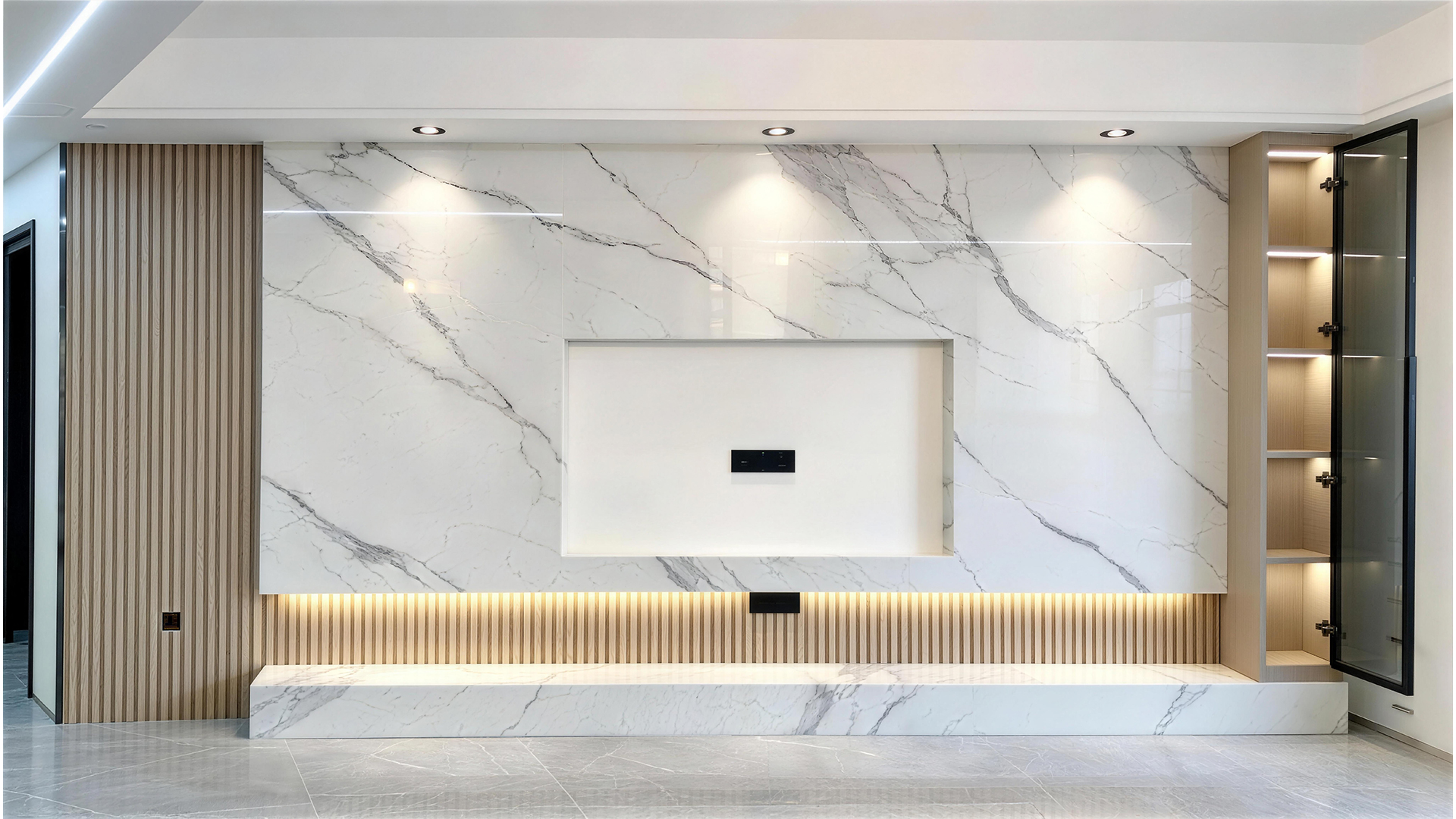
Ask a homeowner where they want panels and nine times out of ten they point at the wall facing the sofa. The TV wall. It's the first thing anyone sees when they walk into the room, and it's where most of our living room orders start. So when importers ask us for PVC wall panels designs for living room projects, what they usually want is a set of TV wall layouts they can show a customer, quote quickly and install without surprises.
That's what this is. Six layouts we see go out of the factory again and again, which finishes suit them, how to count panels, and the one thing contractors get wrong most often: the TV itself.
Why the Living Room Is a Different Brief
A living room isn't a hotel corridor. Nobody bangs a luggage trolley into it. But it is the room people judge a home by, and it's lit in a way most rooms aren't: downlights, a big window, often an LED strip, and a TV screen that's on for hours every evening. Light hits the wall from several directions at once.
That makes two things matter more than usual. The finish has to look right in raking light, up close and from across the room. And the joints have to land where they look deliberate, because on a wall this visible a badly placed seam is the first thing a guest notices.
The upside? It's one wall. Usually four or five panels. That's an easy first sale for a customer who has never bought panels before, and a natural upsell once they've seen it.
Six Living Room and TV Wall Layouts
1. Full-height marble TV wall with a recessed niche
The photo at the top is the reference most buyers send us. Marble-pattern panels floor to ceiling, a shallow niche framing the screen, and a strip of warm light where the wall meets the media plinth. It reads as stone, but it's panels: our marble finish is a PVC board with a marble-pattern PET film laminated to the face, a fraction of the weight of real slabs.
The niche is built from the frame behind the panels, not from the panels themselves. Plan its depth with the TV bracket in mind, and decide the size before you order so the vein pattern can be laid out around it.
2. Marble centre, warm side panels
Look at the same photo again: the marble only fills the middle. Either side, the wall switches to wood grain, here as a fluted band on the left and shelving on the right. Splitting the wall into three bays like this does two jobs. It softens all that white gloss, and it lets you hide the joints where the material changes.
For the fluted band, a narrow run of our WPC fluted profiles works well next to flat PVC panels. Keep the fluting to the side bays. Across the whole wall it gets busy fast.
3. The sofa wall, not just the TV wall
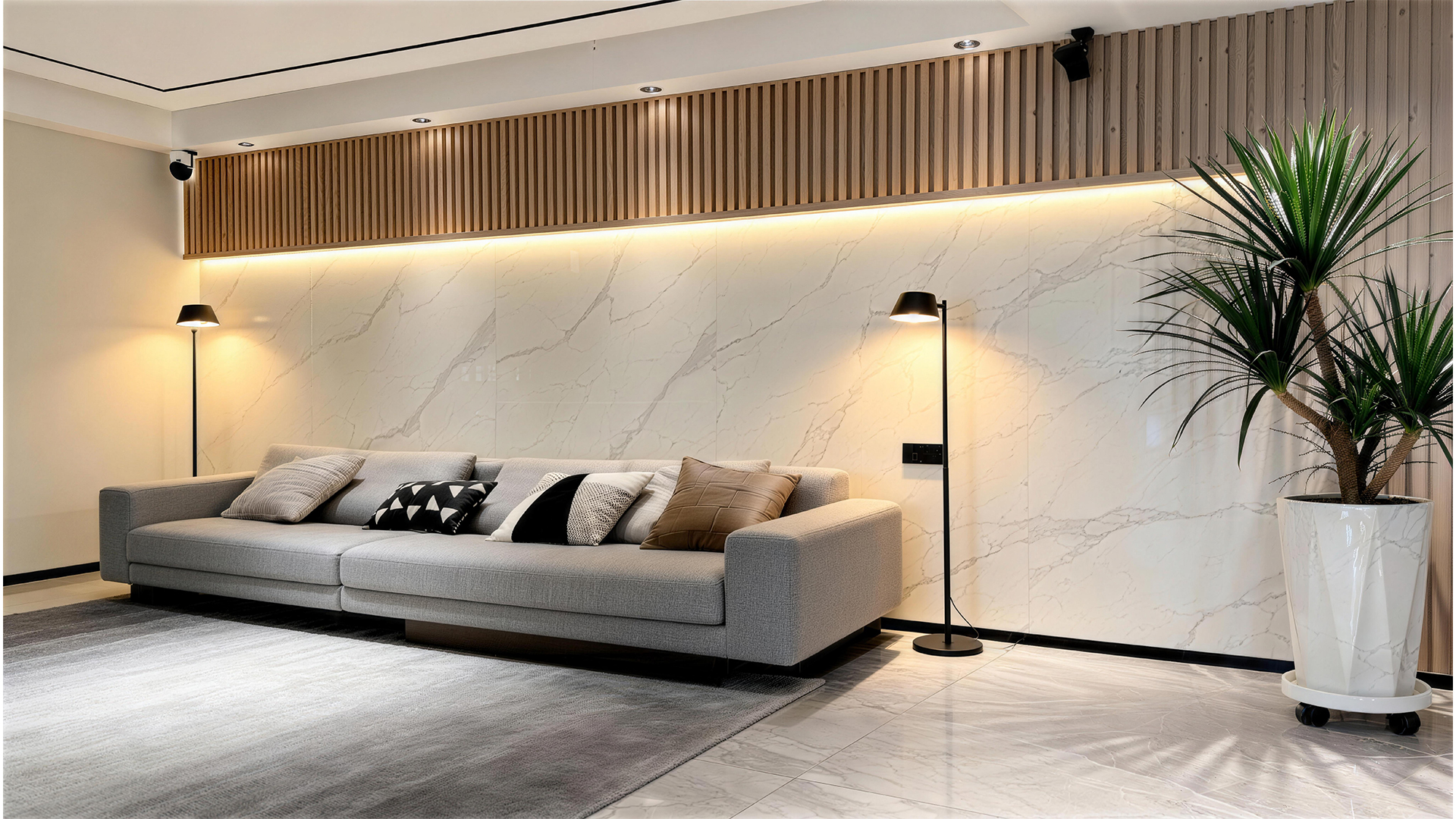
Plenty of customers stop at the TV wall. Then they sit on the sofa, look behind them, and want the other side done too. In the room above, the wall behind the sofa carries the same marble, with a slatted wood band across the top and a warm light line tucked underneath.
If you're quoting a whole living room, quote both walls in the same finish and the same batch. Two walls that face each other make any colour difference between batches very easy to see.
4. Statement stone with a fireplace
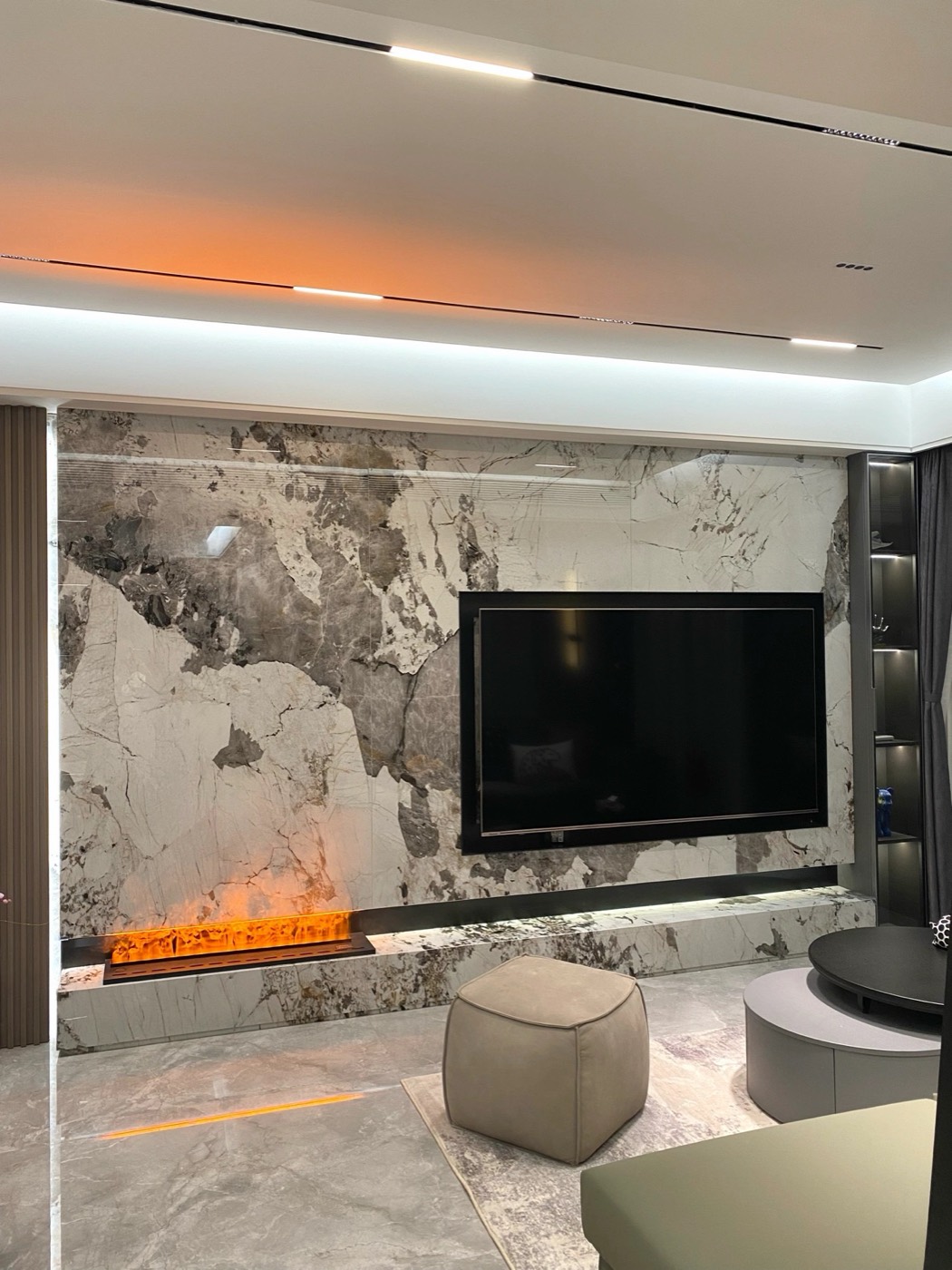
Not every buyer wants white Calacatta. In this project the whole TV wall is a dramatic grey stone pattern, the plinth is clad in the same design, and an electric flame insert sits low on the left. With a pattern this strong, everything else in the room stays quiet: plain ceiling, grey floor, simple furniture.
Bold patterns are a good test of your layout skills. Show the customer how the pattern runs across the joints before installation, not after.
5. Wood grain wall with a hidden door
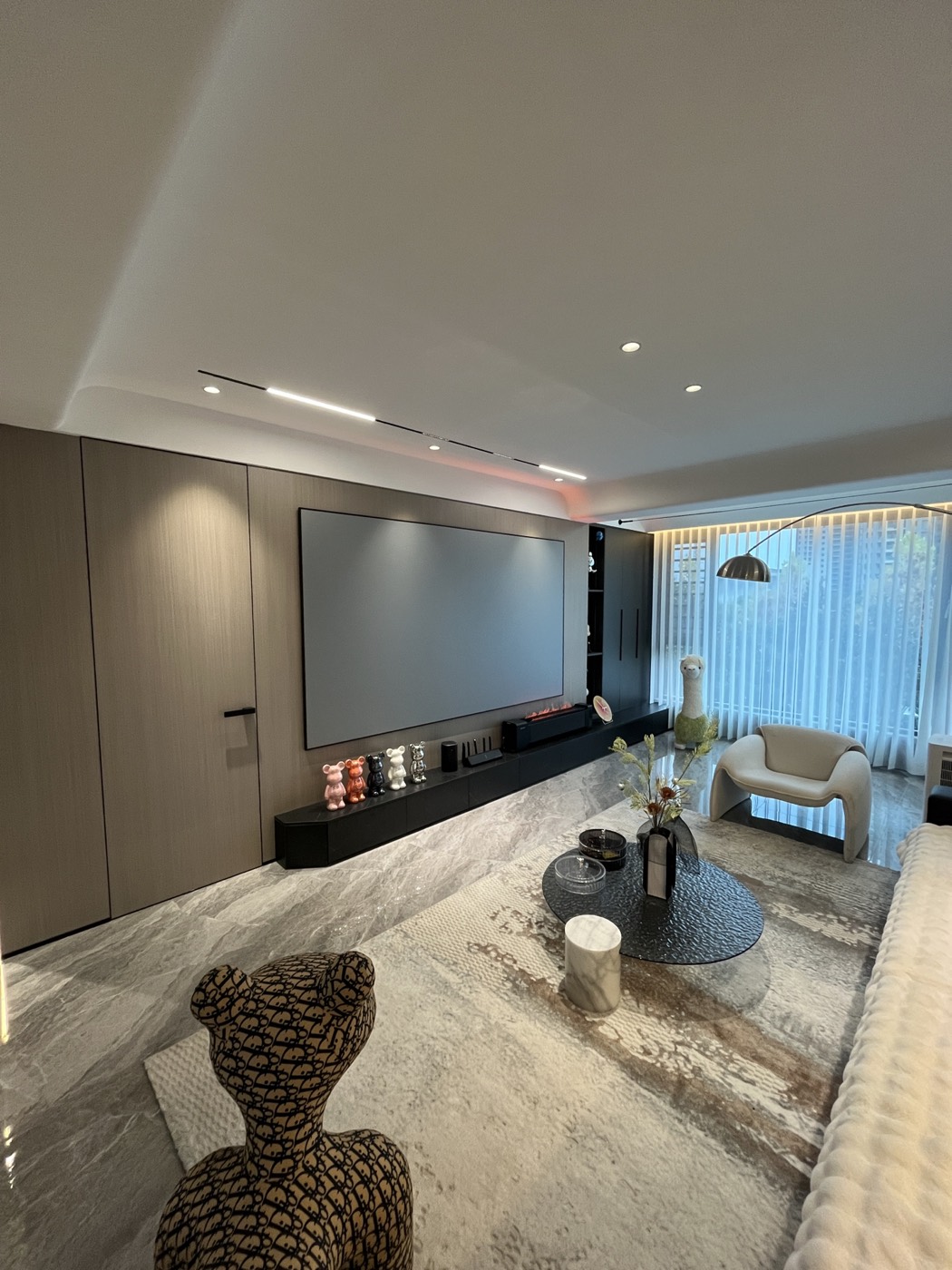
This one is quietly clever. Grey wood-grain panels run the full length of the wall, behind a large projector screen, and straight across a flush door on the left. The door disappears into the wall. It's a popular trick in apartments where the living room opens onto a bedroom or a storeroom and the owner doesn't want a door frame breaking up the feature wall.
Matte wood grain is also kinder to screens. A projector or a TV in a bright room shows every reflection on a glossy wall behind it, and wood grain doesn't play that game.
6. Soft matte with metal lines
For buyers who find marble too loud and wood too rustic, a skin-touch wall in warm grey or beige, divided by thin metal or mirror strips, gives a calm, tailored look. The strips sit in the joints, so the seams become part of the design instead of something to hide. It's also the easiest layout to repeat across many apartments in a development project.
Which Finish for Which Part of the Room
We keep 17 finish series in continuous production. In a living room, they fall into roles:
| Finish series | Best use in a living room | Keep in mind |
|---|---|---|
| Marble (PET film) | The TV wall itself, the sofa wall in a luxury scheme | Gloss reflects downlights and the window; plan lighting from the side |
| Wood grain | Whole walls, walls with hidden doors, side bays next to marble | Order one batch so the tone matches across walls |
| Skin-touch (soft matte) | Large walls, behind projector screens, family rooms | Plain on its own; pair it with trim lines or lighting |
| Mirror | Narrow strips beside the TV, small rooms that need depth | A large mirror facing the screen causes glare |
| Metal | Trim lines and accent strips | Can feel cold across a whole wall |
| Wave pattern | One feature panel, an entrance wall | Strong texture; one wall is enough |
If your customers worry that panels will look like plastic, our article on high-end PVC panel finishes that don't look like plastic covers what separates a convincing finish from a cheap one.
Counting Panels for a TV Wall
Every panel is 1,220 mm wide. Divide the wall width by 1.22, round up, and you have the count. For length, take the size closest to the ceiling height. Standard lengths are 2,440, 2,600, 2,800, 3,000, 3,200, 3,400 and 3,600 mm, which covers most living rooms, including higher ceilings in villas. Custom lengths up to 6 m are possible on bulk orders, useful for double-height living rooms.
| TV wall width | Panels across | Note |
|---|---|---|
| 3.6 m | 3 | Tight fit; no spare for a cut |
| 4.2 m | 4 | One panel cut to width |
| 4.8 m | 4 | Tight fit |
| 5.4 m | 5 | One panel cut to width |
| 6.0 m | 5 | Tight fit |
Then add one spare per wall. A cut that goes wrong around a socket box is common, and a spare from the same batch is far better than a reorder from a different one.
Layout rule: centre the panels on the TV, not on the wall. A joint running straight down the middle of the screen looks like an accident. Start from a panel centred on the TV and let the cut pieces fall at the corners, or behind shelving.
The TV Itself: Mounting and Cables
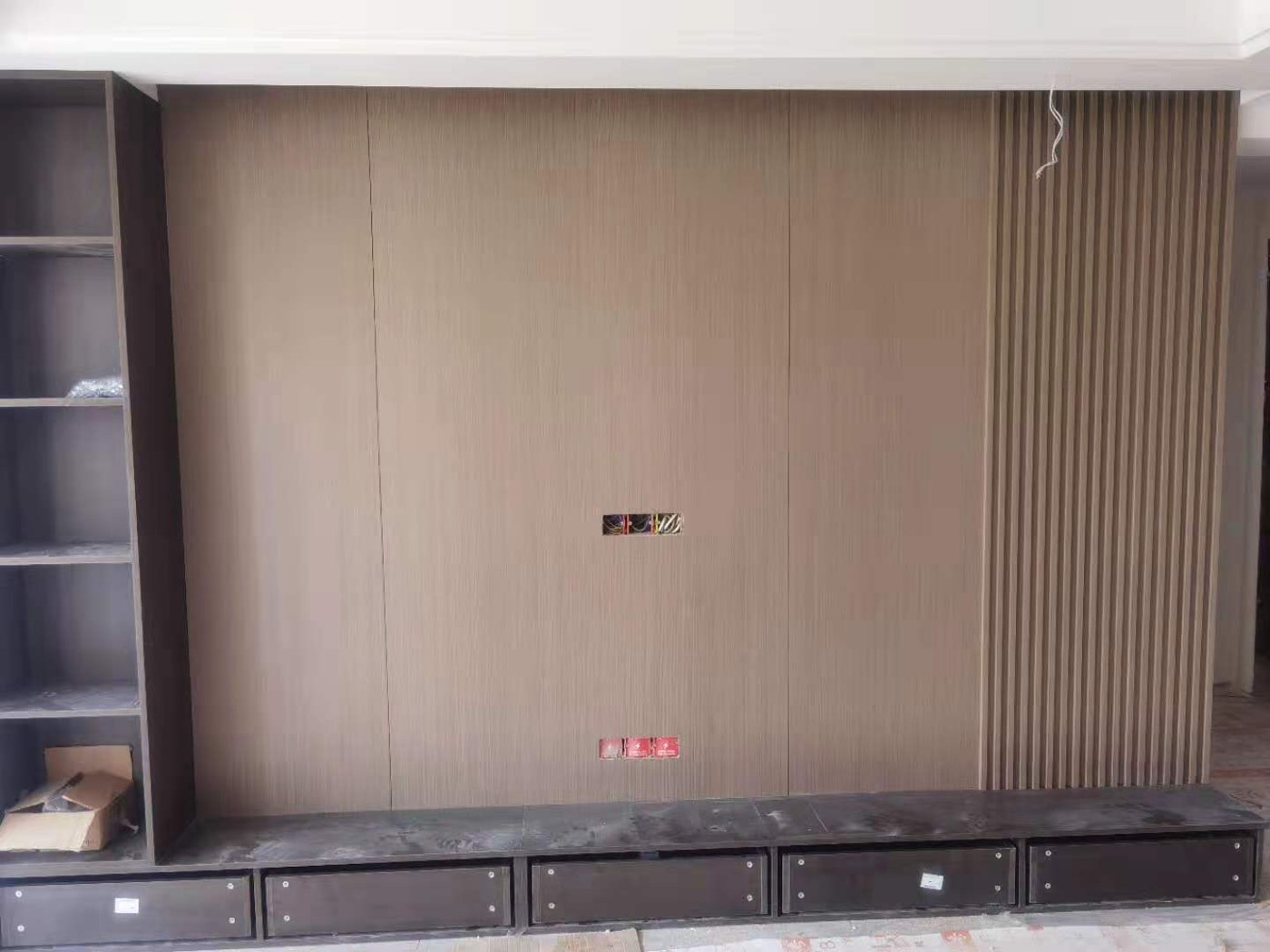
This is where living room jobs go wrong. A PVC wall panel is 5 to 8 mm thick. It's a finished surface, not a structure. A wall-mounted TV, especially a big one on a swing arm, needs its bracket fixed through the panel into the masonry behind it, or into solid timber backing set into the wall before the panels go up. Never into the panel alone.
The photo above shows a TV wall mid-installation. Look at the two rectangular cut-outs: one at TV height for the power and signal cables, one low down for the sockets above the cabinet. Both were marked before the panels were fixed. On site, the sequence is simple:
- Agree the TV size and height with the client before ordering.
- Run conduit for power, HDMI and network cables inside the wall first.
- Fit timber backing or mark the masonry fixing points for the bracket.
- Cut the panel openings to match, then install.
Do it in that order and nobody is drilling holes through a finished marble wall later.
Which Board to Specify
We make the panels in six core constructions. For living rooms, two cover nearly everything:
- 5 mm carbon crystal: 3.25 kg/m², our lightest grade and the lowest freight per m². It flexes enough to wrap columns and curved feature walls without a backing frame, which helps with rounded TV wall ends.
- 7.5 mm carbon crystal: 4.87 kg/m². A stiffer board for tall walls and large flat areas where you want the face to stay dead flat under side lighting.
Panels go straight onto prepared cement walls with structural adhesive or a clip system, so there's no plastering and no drying time. In humid climates that's half the argument for panels: our carbon crystal boards have near-zero water absorption and don't swell or delaminate, while painted living room walls in coastal cities tend to blister. If your customer is still weighing panels against a painted wall, our comparison of PVC wall panels vs drywall and paint lays out when each one makes sense.
Weights, pallet counts and every finish gallery are on our PVC wall panels page.
Living Room, Drawing Room, Hall: Same Wall, Different Words
One practical note for distributors. In India and much of South Asia, customers search for "drawing room" or "hall" designs; in the Philippines and Indonesia, "TV wall" or "wallpanel TV" is common. They mean the same wall. When you build your catalogue or your social posts, use the words your market uses, and lead with TV wall photos. That's what people are trying to picture.
For stock, a tight range sells: two white marbles (one soft vein, one bold), two wood grains (one light, one grey or dark) and a couple of skin-touch neutrals. Mirror, metal and wave work better as order-to-project items.
Planning a TV Wall Range or a Project?
Send us the wall sizes, the finishes you're considering and your destination port. We'll suggest a layout and send samples of the colours you shortlist.
Request Samples & a Quote →Frequently Asked Questions
Can you mount a TV on PVC wall panels?
Not on the panel alone. A 5 to 8 mm panel is a decorative surface, not a structural one. The TV bracket should be fixed through the panel into the masonry wall behind it, or into solid timber backing that is installed before the panels go up. Mark the bracket position and the cable route before installation.
Which PVC wall panel finish is best for a living room?
For large areas, soft matte skin-touch and wood grain are the safest choices because they don't throw reflections back at the sofa. Marble, with its marble-pattern PET film, works best on the TV wall itself as the feature. Mirror and metal are better as narrow accents than as whole walls.
How many PVC panels do I need for a TV wall?
Every panel is 1,220 mm wide, so divide the wall width by 1.22 and round up. A 4.2 m TV wall takes 4 panels, with one cut to width. Choose the length closest to the ceiling height: standard lengths run from 2,440 mm to 3,600 mm, and custom lengths up to 6 m are possible on bulk orders.
Are PVC wall panels a good choice for a drawing room in a humid climate?
Yes. Our carbon crystal panels have near-zero water absorption, so they don't swell or delaminate in humid coastal or monsoon climates, where painted walls often blister or grow mould. The surface wipes clean with a damp cloth and never needs repainting.