PVC Wall Panel Design for Bedroom: Layouts, Finishes & Real Project Photos
Bedrooms aren't lobbies. Most of them are ordinary rooms in apartments, villas and mid-range hotels, and the budget has to work. So when a distributor asks us about PVC wall panel design for bedroom projects, we don't answer with mood boards. We answer with layouts, finishes and panel counts you can actually put on a quote.
This guide is written for importers, distributors and fit-out contractors who need to sell or specify a bedroom wall, not just admire one. Layouts first, then finishes, then the numbers.
Why Bedrooms Suit PVC Wall Panels
A bedroom wall doesn't take much abuse. Nobody wheels a trolley into it ten times a day. What buyers want instead is a finished look, fast, without wet trades in a room the family or the hotel needs back. Panels fit that brief well.
- Install speed. Panels go straight onto prepared cement walls with structural adhesive or a clip system, or over the existing wall. No plastering, no drying time, so the room is back in use sooner.
- Humid climates. Our carbon crystal panels have 0% water absorption. In coastal cities and monsoon climates, from India to Southeast Asia, painted walls in bedrooms often blister or grow mould. Panels don't swell or delaminate.
- Low upkeep. The surface wipes clean with a damp cloth. No repainting every few years.
- Fire rating. B1 flame retardant, which matters once you're selling into hotels and serviced apartments.
Five Bedroom Layouts That Work
Most bedroom walls fall into one of these. Knowing which one your customer wants tells you how many panels, which lengths and which trims to quote.
1. The full headboard wall
The obvious place to start. One wall, behind the bed, clad floor to ceiling; the other three walls stay painted. It gives the room a focal point and keeps the order small, usually three or four panels. If your customer is nervous about panels in a home, start here.
2. Half-height panel with a light line
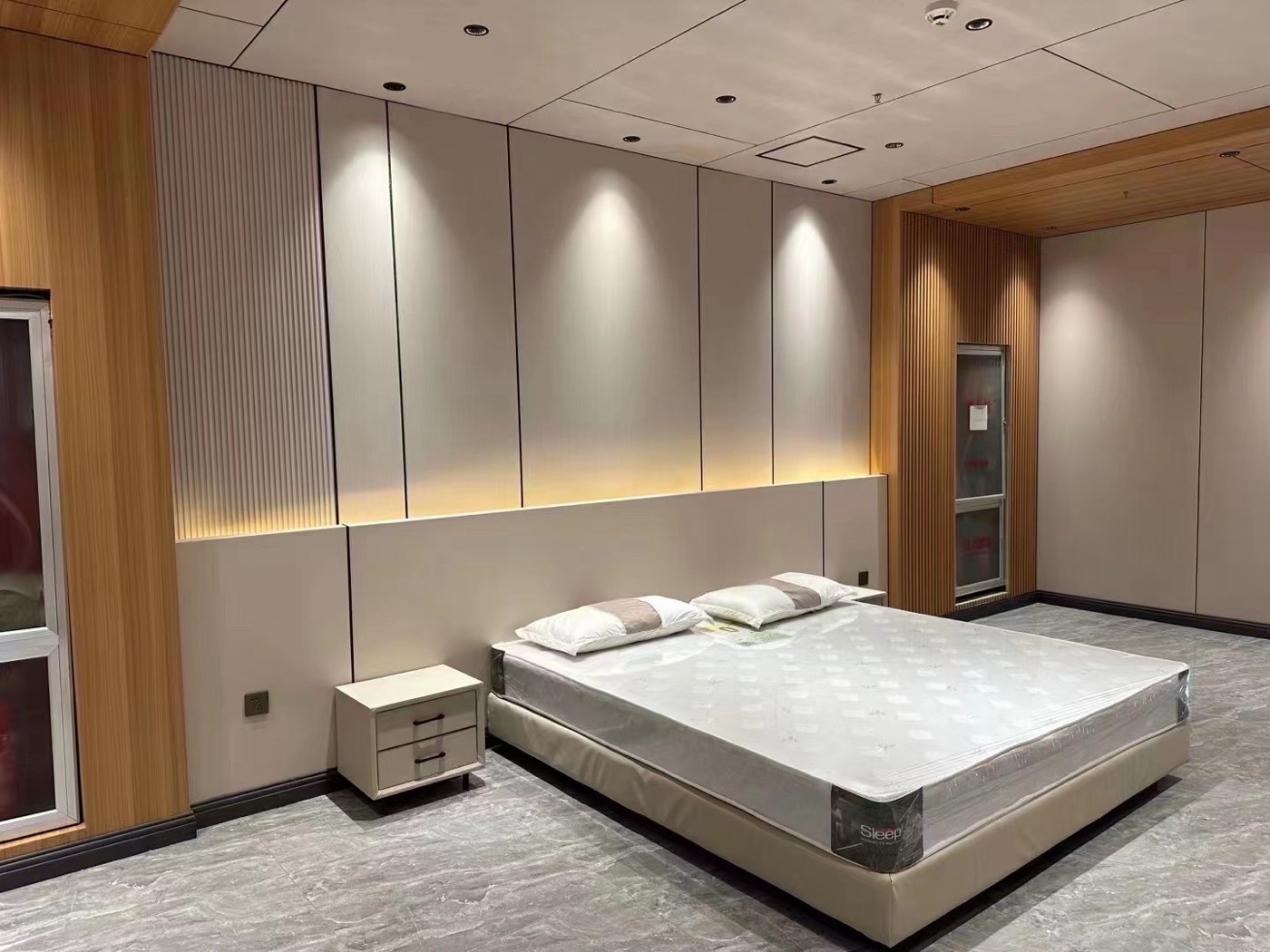
Look at the photo above. The lower band, roughly bed-head height, is one panel layout; above it, a second layout with vertical joints, and a warm LED strip tucked into the step between them. It reads like custom joinery, but it's standard panels cut to height. It suits hotels too, because the lower band takes the knocks from pillows and headboards.
3. Wood grain all round
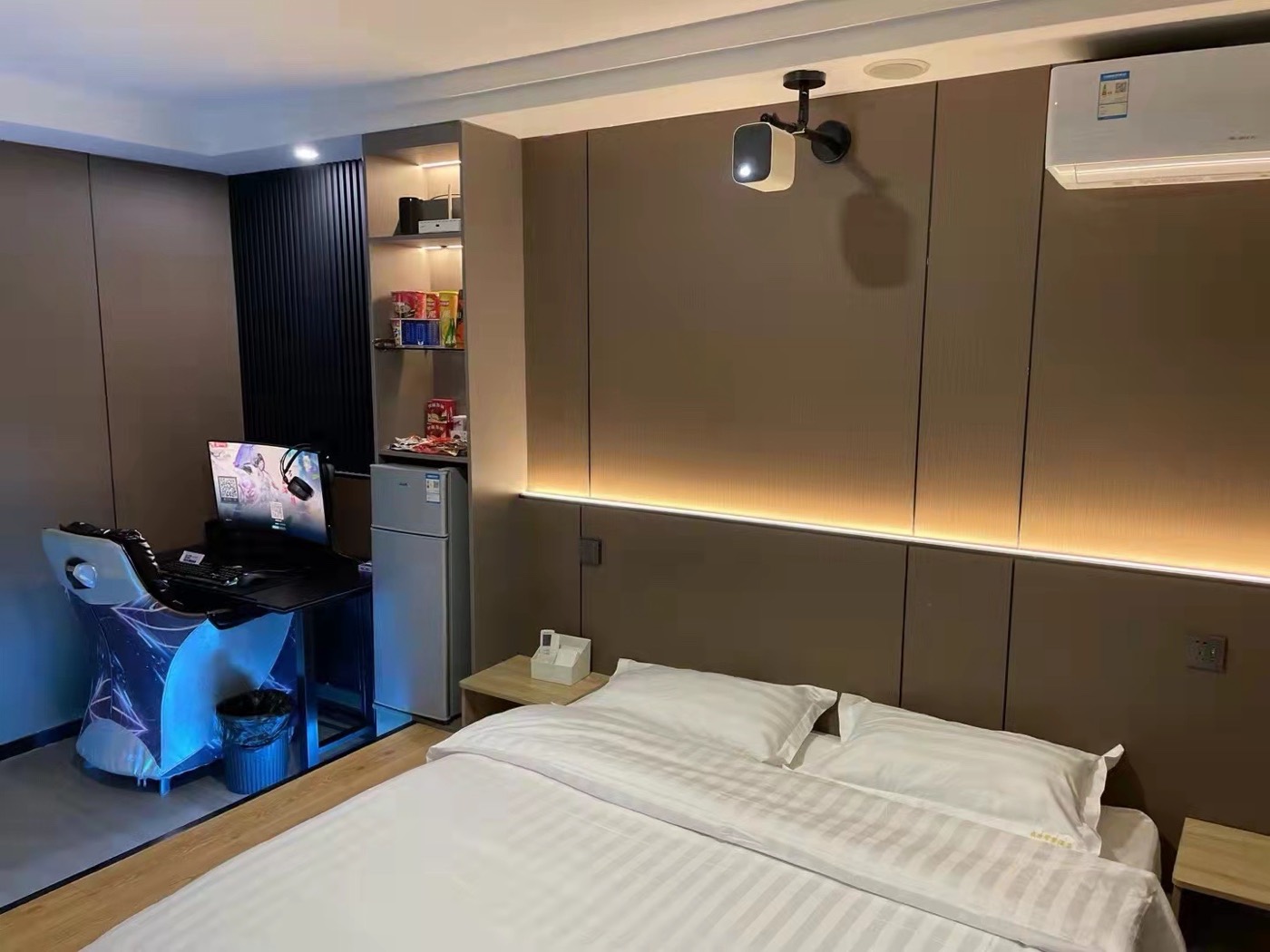
Common in hotel guest rooms and in markets where buyers want a "warm" room, like the guest room above. Wood grain on every wall, sometimes on the ceiling too, with a contrasting colour or a slatted accent near the desk. It's a bigger order, and the finish has to match from wall to wall, so supply from one production batch.
4. Panel grid with metal strip lines
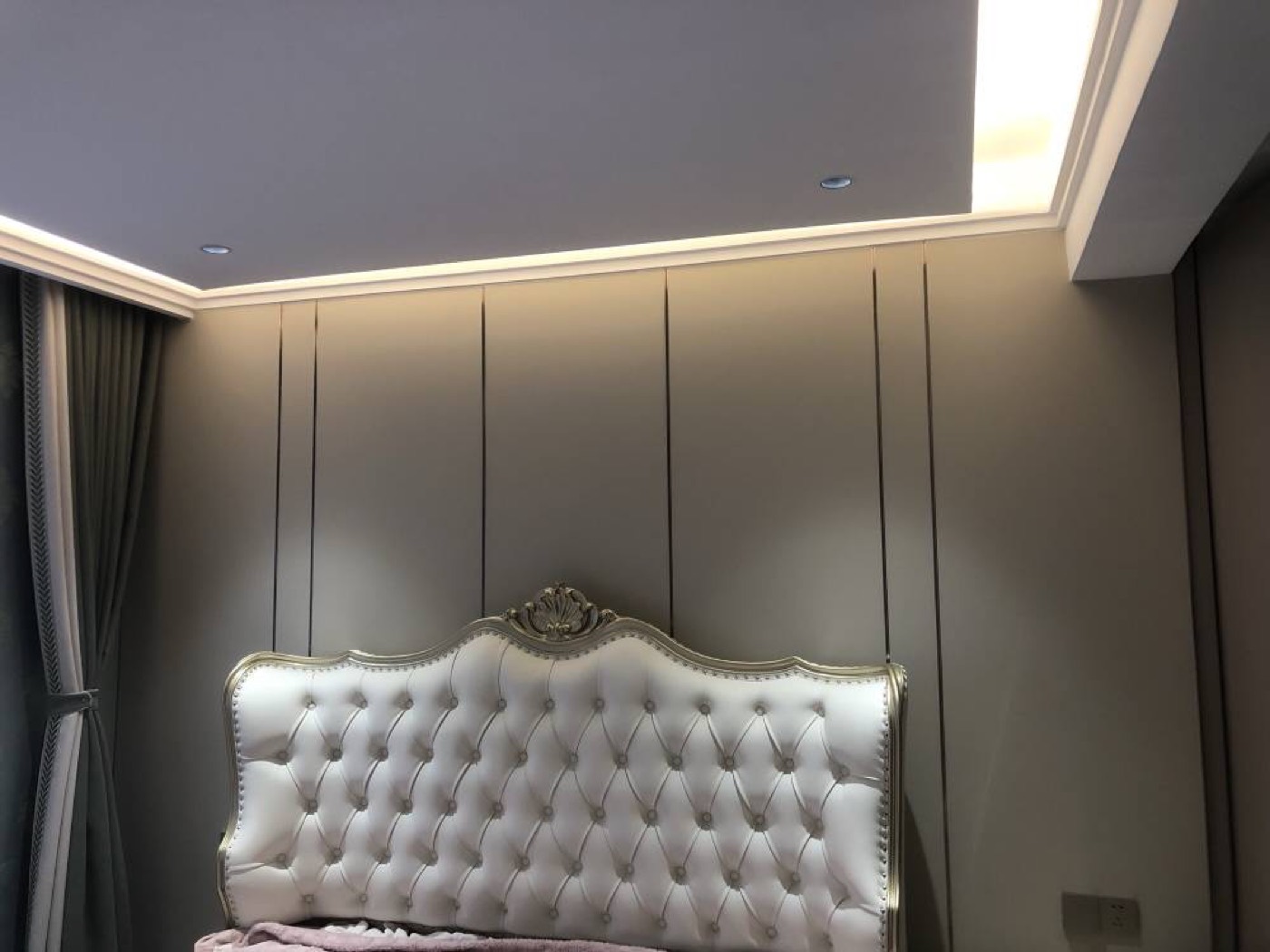
A quieter, more formal look. Flat panels in a soft grey or beige, with thin metal trim strips set into the joints so the wall is divided into tall vertical bays. It suits classic furniture, as in the photo below, and it hides the joints rather than fighting them.
5. One statement panel
A single marble or mirror panel directly behind the bed, framed by plainer panels either side. It gets the luxury look for the cost of one or two premium sheets, and it's a handy upsell for distributors: the customer already buying plain panels adds one special.
Choosing a Finish for a Room People Sleep In
Bedrooms have one condition other rooms don't: the lights are low and close. A bedside lamp or a ceiling spotlight a metre from a glossy wall throws hard reflections straight back at the bed. That changes which of our 17 finish series belong on the big surfaces.
| Finish series | Where it works in a bedroom | Watch out for |
|---|---|---|
| Skin-touch (soft matte) | Main walls, full headboard walls, whole rooms | Very little; the safest choice for large areas |
| Wood grain | Whole rooms, hotel guest rooms, ceilings | Order one batch so the grain colour matches across walls |
| Marble (PET film) | Headboard panel, TV wall in a master bedroom | High gloss reflects lamps; keep it to one wall |
| Mirror | Narrow strips beside the bed, wardrobe fronts, small rooms | Avoid a large mirror area directly facing the bed |
| Metal | Trim lines, accent strips, modern rooms | Can feel cold over a whole wall |
| Wave pattern | A single feature panel | Strong pattern; tiring on more than one wall |
On marble: our marble panels are a PVC board with a marble-pattern PET film laminated to the face. They give the polished-stone look at a fraction of the weight and cost of real stone, which matters on an upper-floor bedroom wall. But it's still a gloss surface, so place the lamps to the side rather than straight in front of it.
For a closer look at how each finish behaves up close, our article on high-end PVC panel finishes that don't look like plastic covers the details.
Sizing a Bedroom Wall: The Quick Maths
Every panel is 1,220 mm wide. Divide the wall width by 1.22, round up, and that's the panel count for the wall. Then pick the length closest to the ceiling height so offcuts stay small. Lengths run 2,440, 2,600, 2,800 and 3,000 mm and on up to 3,600 mm; custom lengths up to 6 m are possible on bulk orders.
| Headboard wall width | Panels across (1,220 mm) | Typical length for a 2.7–2.8 m ceiling |
|---|---|---|
| 3.0 m | 3 (one cut to width) | 2,800 mm |
| 3.6 m | 3 | 2,800 mm |
| 4.2 m | 4 (one cut to width) | 2,800 mm |
| 4.8 m | 4 | 2,800 mm |
One layout tip: centre the layout on the bed, not on the wall. If the joint lands right behind the middle of the headboard, it looks like a mistake. Start from a panel centred on the bed and let the cut pieces fall at the corners.
Mark sockets, bedside switches and reading-light positions on the wall before the first panel goes up. For their size, bedrooms need a lot of cut-outs.
Which Board for Which Bedroom
We make the panels in six core constructions. For bedrooms, two cover most jobs:
- 5 mm carbon crystal: 3.25 kg/m², our lightest grade and the lowest freight per m². It flexes enough to wrap columns and curved feature walls. Right for homes and apartments.
- 7.5 mm anti-collision: 6.38 kg/m², 850 kg/m³. Built for hotel guest rooms and corridors where luggage and housekeeping trolleys hit the walls every day.
For freight planning: a pallet of 5 mm carbon crystal in 1.22 × 2.44 m holds 196 panels, about 583 m², at a standard 2,000 kg gross. The full weight and pallet table, plus every finish gallery, is on our PVC wall panels page.
What to Stock as a Distributor
If you're stocking for a bedroom market rather than quoting one project, keep the range tight. A sensible starting stock is two or three skin-touch neutrals (light grey, beige, warm white), two wood grains (one light, one dark) and one or two white marbles. That covers most bedroom enquiries. Mirror, metal and wave usually work better as order-to-project items than as stock.
And show customers real rooms, not just samples in the hand. A 20 cm chip of soft grey looks dull; the same colour over a whole headboard wall with a light strip, like the hero photo above, is what closes the sale.
Installation Notes Specific to Bedrooms
The general method is the same as any room, and our step-by-step PVC wall panel installation guide covers tools, prep and corners. Three points come up more in bedrooms:
- LED strip channels. Decide on lighting before ordering. The step between a half-height band and the upper wall has to be planned, not improvised on site.
- Wardrobes and built-ins. Panel the wall first, then fit wardrobes, or leave the wall behind a built-in bare. Don't trap a panel half behind a cabinet.
- Curtain tracks and headboards. Anything screwed into the wall needs a fixing point behind the panel. Mark them before installation.
Planning a Bedroom Range or a Hotel Room Refit?
Send us the room sizes, the finishes you're considering and your destination port. We'll suggest a panel layout and send samples of the colours you shortlist.
Request Samples & a Quote →Frequently Asked Questions
Are PVC wall panels suitable for bedrooms?
Yes. Bedrooms are a natural fit for our PVC wall panels. The panels are B1 flame retardant, have 0% water absorption, so they stay stable in humid climates, and they are wiped clean with a damp cloth. The headboard wall is the usual starting point, and the same panels can clad the whole room.
Which PVC panel finish is best for a bedroom?
For the main walls, a matte finish such as our skin-touch series or a wood grain is the safest choice, because it does not throw back glare from reading lights. Marble, mirror and metal finishes work best as smaller accents: a headboard panel, a strip beside the bed or a wardrobe front.
How many PVC panels do I need for a bedroom wall?
Divide the wall width by 1.22 m and round up. A 3.6 m headboard wall takes 3 panels, a 4.2 m wall takes 4. Then choose the panel length closest to your ceiling height: 2.44, 2.6, 2.8 or 3.0 m and longer. Add one or two spare panels per finish for cut-outs and future repairs.
Which thickness should I use for bedroom walls?
For homes and apartments, the 5 mm carbon crystal board is usually enough. It weighs 3.25 kg/m² and flexes around curved walls and columns. For hotel guest rooms, where luggage and housekeeping trolleys hit the walls, the 7.5 mm anti-collision board is the better choice.