How We Grade Panel Core Density: A Factory QC Walkthrough
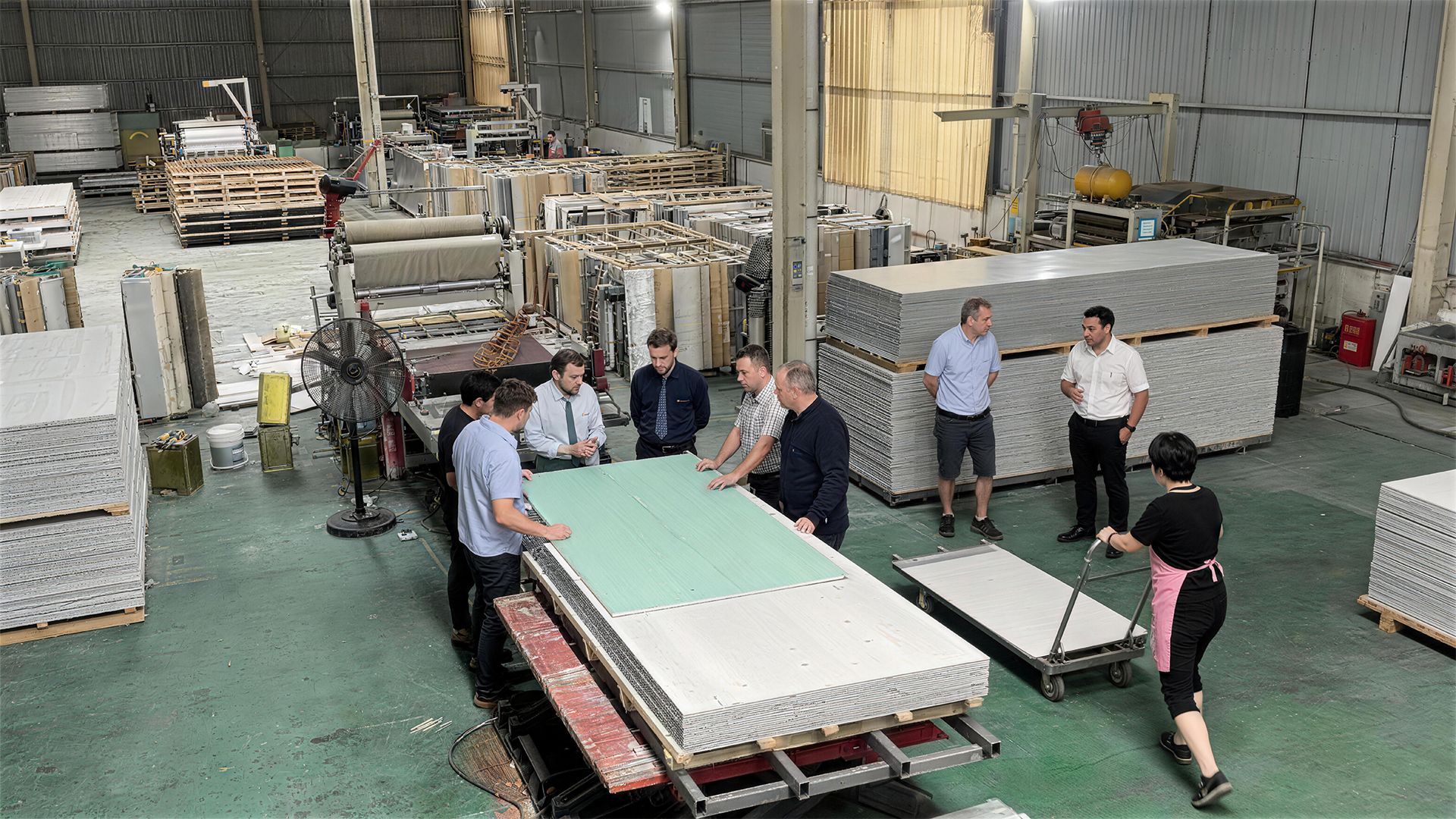
We've already written about why thin, under-cored panels crack from a buyer's perspective — thickness, grade, what to look for on a spec sheet. This is the other half of that story: what actually happens on our production floor to make sure the panel that ships matches the spec sheet in the first place. Core density isn't something we eyeball. It's tested batch by batch, and batches that fail don't get relabeled and sold quietly — they get pulled. Here's the walkthrough.
The Short Answer
Core density is verified by weighing sample coupons cut directly from each production batch and comparing that weight against the target density band for the grade being run, not by visual inspection or trusting the extrusion recipe on paper. A batch that falls outside its band gets held, reworked or downgraded before it ever reaches the packing line — the panel a buyer receives has already passed this check, not just the machine setting that was supposed to produce it.
Why Density Testing Exists at All
A panel's core is an extruded mix of PVC resin and mineral filler — calcium carbonate for carbon crystal grades, bamboo-charcoal powder for our bamboo crystal line — and the ratio between resin and filler is what determines rigidity, not the panel's visible thickness alone. Two panels can measure identically at 5 mm with a caliper and still perform completely differently under load if one batch ran filler-light to save material cost. Thickness is what a buyer can check with a tool on arrival; density is what actually determines whether the panel holds its shape over a 3 m span, and it can only be verified by weight, not by eye.
How a Batch Gets Tested
Sample coupons are cut from the extrusion run at set intervals through a production shift, weighed, and checked against the density band specified for that grade — a process closer to a materials lab than a visual QC pass. Filler ratio is cross-checked with a loss-on-ignition test: a sample is burned to remove the polymer content entirely, and the mineral residue that's left is weighed to confirm it matches the recipe for that grade rather than a lighter, cost-cut version of it. A batch that reads outside its target band gets flagged before it reaches the cutting and packing stage — this is a mid-process check, not a final inspection on finished stock, which is what makes it possible to catch a drifting extrusion setting before an entire day's output ships in it.
| Grade | Thickness | Core | Density QC Focus |
|---|---|---|---|
| A — Carbon Crystal | 5 mm | Carbon crystal composite | Standard filler-ratio and coupon weight check |
| C — Bamboo Crystal | 5 mm | Bamboo-charcoal composite | Standard filler-ratio and coupon weight check |
| B / D — 7.5 mm range | 7.5 mm | Carbon or bamboo-charcoal composite | Tighter density band for commercial-span rigidity |
| E — Anti-Impact | 7.5 mm | Reinforced impact-resistant core | Density check plus impact-resistance sampling |
| F — SPC | 8 mm | Limestone + PVC composite | Limestone-ratio verification via loss-on-ignition |
What Happens to a Batch That Fails
A batch that reads below its target density band doesn't get quietly sold under a different label — it gets held for rework or, if the resin-to-filler mix drifted too far to correct, reground and fed back into the extruder as raw input rather than finished panel. This matters to a buyer because it's the difference between a factory that treats density as a hard gate before packing and one that treats it as a number on a datasheet that nobody checks against the actual output. The cost of catching a bad batch mid-shift is a few hours of reground material; the cost of catching it after a container has landed at a customer's port is a rejected shipment and a damaged relationship — which is the entire reason this check happens on the line rather than at final inspection.
Third-Party Verification: Pre-Shipment Inspection
Internal QC catches problems before a batch is even packed, but buyers shouldn't have to take a factory's word for it on a full container. A pre-shipment inspection (PSI) by an independent agency — SGS, Bureau Veritas or Intertek are the three buyers ask for most often — lets a third-party inspector pull random cartons from the loaded batch, check panel thickness and surface quality against the purchase order, and sign off before the container seals. We treat this as standard practice for new buyers, not an inconvenience: a supplier who resists a PSI request on a first order is telling you something about how confident they are in their own QC.
What This Means When You're Vetting a New Supplier
Ask for the batch test record behind the spec sheet, not just the spec sheet itself — any factory running real density QC can produce a sample test log showing coupon weights against target bands for the grade you're ordering. If a supplier can only offer a generic product datasheet with no batch-level test data behind it, that's usually because the testing isn't happening at batch level at all. Our soak, burn and bend test guide covers what you can verify yourself on a free sample before you even get to this stage.
Honest Limits: What QC Can't Fix
Density QC controls consistency within a grade — it can't rescue a project that was specified below the minimum viable thickness for its use case in the first place. If a buyer or their client insists on a sub-4 mm panel to hit a price target, no amount of batch testing changes the fact that a profile that thin doesn't have enough material in the click-lock edge to stay rigid over a full-height span, regardless of how tightly its density is controlled. Our QC process guarantees the panel you receive matches its grade — it doesn't substitute for choosing the right grade for the job.
Want to See a Batch Test Record?
Ask and we'll send a sample density test log for the grade you're sourcing, plus arrange third-party PSI on your first container if you'd like independent verification.
Request a Quote →Frequently Asked Questions
How can I tell if a panel batch was actually QC'd before it shipped?
Ask your supplier for the batch test record — coupon weights or density readings compared against the target band for that grade. A datasheet alone, with no batch-level data behind it, isn't the same thing.
Do you test every panel, or just samples from each batch?
Samples, cut at set intervals through a production run. Testing every single panel isn't practical at production volume, but interval sampling through a shift catches a drifting extrusion setting before the whole run ships in it.
What's a loss-on-ignition test?
A sample is burned to remove all polymer content, leaving only the mineral filler behind. Weighing that residue confirms the actual filler ratio in the core matches the recipe for that grade, rather than a lighter, cost-cut version.
Can I request my own inspector before the container loads?
Yes. A pre-shipment inspection through SGS, Bureau Veritas or Intertek is standard practice for new buyers, and we'd recommend it on a first order regardless of which supplier you're working with.
Does core density affect anything besides cracking?
Yes — it also affects how flat a panel lies during installation, how well it holds screws and fixings at cut edges, and how it responds to sustained heat exposure near kitchens or heaters.