PVC Fluted Panel vs WPC Fluted Panel: Core, Weight & Where Each Fits
The search term "PVC fluted panel" covers at least two different products that look almost identical in promotional photos. One is extruded mainly from PVC resin with a hollow or thin-wall profile. The other — the WPC fluted panel — has a bamboo-wood fibre composite core that makes it noticeably denser. If you're placing a container order, that difference matters: it shows up in the weight per square metre, the way the surface holds up in a busy hotel corridor, and the kind of substrate and fixing method the wall needs.
We make WPC fluted panels. We don't make the PVC-only version. So this comparison is written from the perspective of a factory that knows one side of the table very well and watches the other side of it closely.
Why the Naming Gets Confusing
The surface of most fluted profiles — WPC included — is a decorative film. On our WPC panels that film is a PET-laminated wrap in wood grain or solid colours. Because the outer layer is PVC-adjacent or PET film, some suppliers in the market list their WPC panels as "PVC fluted panels" or "PVC slat wall panels." Buyers searching that term often receive both types in their supplier shortlist without realising they're comparing different cores.
It gets more complicated because "bamboo charcoal board," "bamboo fibre panel," and "wood-plastic composite panel" all refer to the same WPC material, just marketed with different brand emphasis. So one supplier calls the product a PVC fluted panel, another calls it a bamboo fibre wall panel, and a third calls it a WPC fluted panel. Same physical thing, three different names.
The quick test: ask for a cross-section photo of the profile end. A pure PVC panel has thin extruded walls and a large hollow chamber. A WPC panel has a denser, more filled cross-section — you can see it in the colour and texture of the cut end.
What a PVC Fluted Panel Actually Is
In its simplest form, a PVC fluted panel is extruded from polyvinyl chloride resin blended with stabilisers and mineral fillers. The wood content is very low or zero. The result is a lightweight profile with thin walls and a hollow core. Surface finish can range from plain extruded PVC colour to a printed film applied during or after extrusion.
These panels are common in markets like India and Southeast Asia where they're used for partition walls, interior cladding in residential projects, and sometimes ceilings. Because PVC is relatively easy to extrude and the material is inexpensive, there are many manufacturers producing them, and the variation in quality is wide.
The main practical advantages are weight and ease of handling. A lightweight hollow PVC profile goes up quickly, is easy to cut with a handsaw, and can be adhesive-mounted on almost any flat surface without worrying about the substrate's load capacity.
The limitations: the hollow walls feel noticeably thinner to the touch, the profile can flex under pressure in a way that a denser WPC won't, and without a proper film the surface may not hold its finish as long in high-traffic commercial spaces.
What a WPC Fluted Panel Is
WPC — wood-plastic composite — combines bamboo-wood fibre with thermoplastic binders. In our extrusion process, the bamboo-wood content gives the profile a density and rigidity you can feel when you hold a length alongside a hollow PVC equivalent. The surface is film-wrapped: a decorative PET film bonded to the profile during manufacturing, available in wood grains and solid colours.
We produce seven profiles, ranging from the 150 mm half-round (15 mm deep) to the 210 mm acoustic panel. Each profile is designed for interior feature walls — not exterior cladding, not wet areas. The profiles come in four standard lengths: 2,440, 2,600, 2,800 and 3,000 mm.
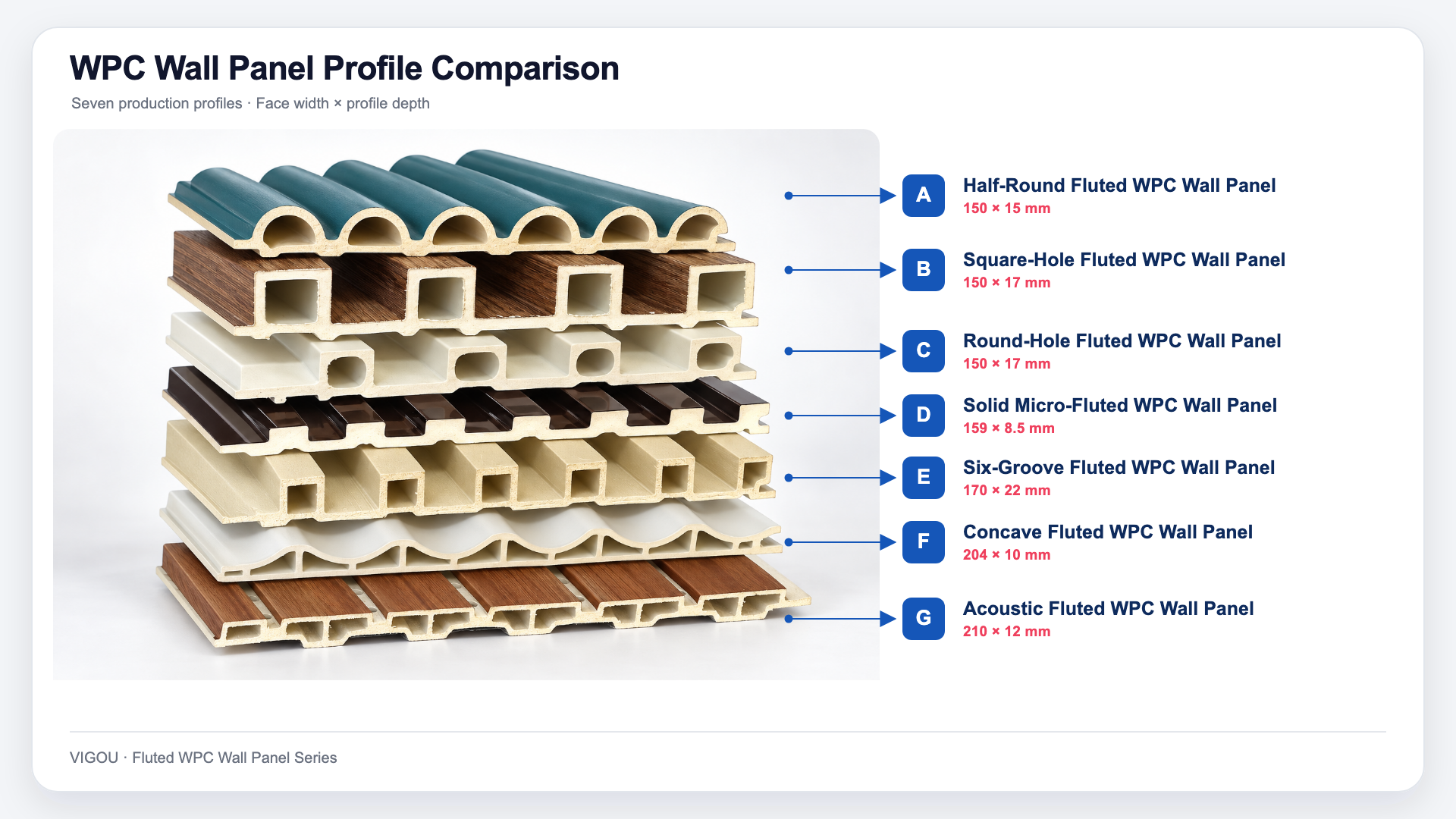
What importers usually notice first when they compare our WPC samples to a PVC-only equivalent is the weight and the cross-section. The filled core sounds different when you knock it, and the cut end shows a denser profile rather than a thin shell around an empty chamber. That density is also what makes the film adhesion more stable long-term — there's a solid substrate for the film to bond to, rather than a thin wall that flexes.
Core, Weight and Surface — Side by Side
| Property | PVC fluted panel (typical market product) | WPC fluted panel (VIGOU) |
|---|---|---|
| Core material | PVC resin + mineral stabilisers, low or no wood content | Bamboo-wood fibre + thermoplastic binder (wood-plastic composite) |
| Profile structure | Thin hollow walls, large internal voids | Chambered or solid depending on profile; denser wall sections |
| Typical weight feel | Light; some flex under hand pressure | Heavier; rigid, minimal flex |
| Surface finish | Extruded PVC colour, printed film or laminated film (varies by maker) | Film-wrapped with PET decorative film, wood grain or solid colour |
| Profile widths | Varies by manufacturer, often 100–200 mm | 150 / 159 / 170 / 204 / 210 mm (seven profiles) |
| Profile depths | Varies | 8.5 / 10 / 12 / 15 / 17 / 22 mm |
| Standard lengths | Varies by manufacturer | 2,440 / 2,600 / 2,800 / 3,000 mm |
| Typical applications | Residential cladding, partition walls, ceilings in lower-budget projects | Feature walls, TV walls, hotel lobbies, office receptions, restaurants |
Where PVC Fluted Panels Make Sense
If the brief is a residential apartment project with a moderate budget and the walls are going up in bedrooms or a living room where daily foot traffic is light, a PVC fluted panel can do the job. The installation is straightforward — the profiles are light, installers handle them easily, and cutting is fast. For projects where the client will refresh the interiors in a few years anyway, the lower cost per square metre is a reasonable trade-off.
Ceilings are another case where the lighter weight of a pure PVC profile can be an advantage. Every gram on an overhead suspension counts, and if the ceiling is a simple flat grid installation in a residential space, the extra rigidity of WPC isn't adding value.
The same applies to light partition work — small internal dividers, decorative screens, areas where the panel is not going to take knocks.
Where WPC Fluted Panels Fit Better
Hotel lobbies, restaurant dining rooms, office receptions, retail display walls — these are the environments where the difference between a PVC and a WPC fluted panel tends to show itself in the first year after installation. The denser WPC core resists the light impacts that happen in a commercial interior: chair backs, luggage handles, maintenance trolleys passing close to the wall.
They're also the right call when the wall is a primary feature of the room. A hotel designer specifying the lobby knows that guests will touch the wall, stand close to it, notice its quality. A hollow PVC profile that flexes when pressed tells a story you don't want told in that setting.
TV walls and headboard walls in residential projects are another strong use case — not because of durability, but because the substrate for a TV bracket needs to be solid, and the fluted panel needs to sit flat and stable over time. For more on how the two materials compare in terms of base product, the article on SPC vs PVC wall panels covers the flat panel versions in detail.
For acoustic requirements — meeting rooms, studios, bars — our 210 mm acoustic profile has a perforated back with acoustic backing that actually absorbs sound, rather than just breaking up reflections the way a plain fluted surface does.
What to Check Before You Place an Order
When you're evaluating a supplier for either type, a few checks narrow down the quality quickly:
- Ask for a cross-section photo. A hollow PVC profile shows large voids between thin walls. A WPC profile shows a filled, denser cross-section.
- Request a sample and weigh it. Weigh a 300 mm length of the same nominal size from two suppliers. The denser core produces a measurably heavier piece.
- Check the film adhesion. Bend the sample. On a well-bonded film, you won't see delamination at the bend. On a poorly bonded film, the edge starts to lift.
- Confirm the face width and depth. These two dimensions determine how many pieces per wall and how much relief the groove creates. Our WPC wall panel product page lists both dimensions for each of the seven profiles, so you can calculate coverage and joint count before ordering.
- Ask about the finish colour consistency across batches. Film-wrapped profiles hold colour better across batches than extruded PVC colour, which can shift with raw material variation.
The Bottom Line for Importers and Distributors
For a buyer placing a container order, the choice between PVC and WPC fluted panels is essentially a decision about which end of the market you're stocking for. PVC fluted panels serve the residential and low-to-mid budget segment well, particularly in markets like India and Southeast Asia where the product category is established and price sensitivity is high.
WPC fluted panels sit higher in the value chain. The denser core, the more stable film adhesion, and the wider range of profiles make them the more defensible specification for commercial interiors and for distributors selling to architects and hotel procurement teams. The conversation with a buyer shifts from "what does this cost per square metre" to "which profile works for the lobby and which works for the corridors."
Many of our distributor customers in Europe and the Middle East stock both flat PVC wall panels and our WPC fluted profiles. The PVC sheets handle the large wall areas; the WPC profiles go on the feature walls. That combination lets them cover a wide range of project types from one supplier relationship.
For a deeper look at how the base materials compare across the full product range — including SPC — the carbon crystal wall panel explainer covers the naming conventions and material differences that come up most often in import inquiries.
Samples of All Seven WPC Profiles
Tell us which profiles you want to compare, the finishes you're evaluating, and your destination port. We'll arrange samples and a container quotation.
Request Samples & a Quote →Frequently Asked Questions
Is a PVC fluted panel the same as a WPC fluted panel?
No, though the names are often used interchangeably in supplier catalogues. A PVC fluted panel is extruded primarily from PVC resin, with thin walls and a low wood content. A WPC fluted panel uses a bamboo-wood fibre composite core, which makes it denser and heavier per linear metre. The surface finish on both can be a decorative film, so they can look identical in photos — which is why it matters to request a cross-section photo or a sample before ordering.
Which is heavier — a PVC fluted panel or a WPC fluted panel?
WPC profiles are heavier. The bamboo-wood fibre in the core increases density compared with a hollow PVC extrusion. For a large feature wall or a hotel lobby, that extra weight is not usually a problem because the panels are fixed to battens or adhesive-mounted. For a ceiling or a partition where the substrate is light, check the structural allowance before specifying WPC.
Can WPC fluted panels be used in a bathroom or wet area?
Our WPC fluted profiles are specified for interior feature walls — bedrooms, hotel lobbies, offices, restaurants and retail. They are not rated for continuous wet exposure. For shower walls and bathrooms, the right product is an SPC wall panel, which is a stone-plastic composite designed for wet areas.
What is the minimum order for WPC fluted wall panels from VIGOU?
Our minimum order is one 20 ft container. Free samples are available for qualified buyers — send us the profile code, the colour and your destination port and we will arrange them.