SPC vs PVC Wall Panels: Which Should You Import?
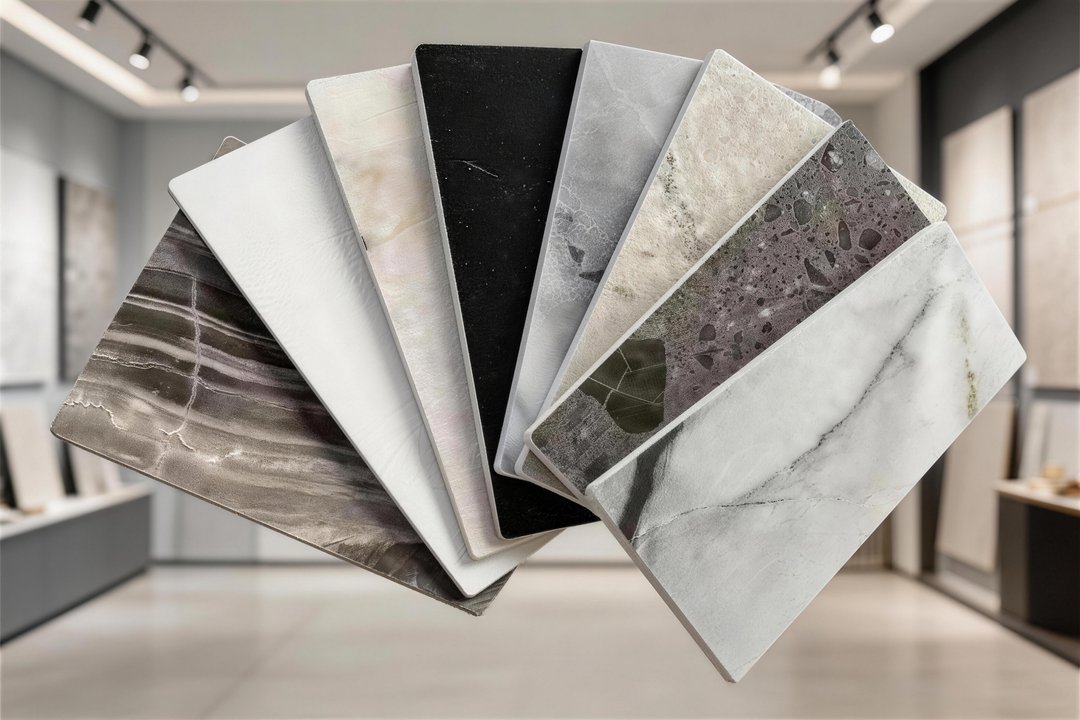
If you are sourcing wall panels from China, the first fork in the road is almost always the same: SPC (Stone Plastic Composite) or PVC-based panels? Both are waterproof, both install far faster than tiles, and both come out of similar factories — yet they behave differently on the wall, ship differently in a container, and sell to different customers.
We manufacture both. Here is the comparison we walk every new importer through, with real specifications rather than marketing adjectives.
The Short Answer
- Choose SPC panels for bathrooms, kitchens and hotel wet areas — higher density, stone-like rigidity, best-in-class water performance.
- Choose PVC / carbon crystal panels for living rooms, bedrooms, offices and feature walls — lighter, wider design range (wood, metal, mirror, fabric textures), lower cost per square meter.
- Most of our distributors import both in one container: SPC for wet zones, carbon crystal for dry zones. The two lines share trims and installation methods, so contractors only learn one system.
What Each Panel Actually Is
SPC Wall Panels
SPC boards are made from a compressed mixture of natural limestone powder (calcium carbonate) and stabilized PVC. The result is a dense, rigid sheet that feels closer to stone than plastic — dimensionally stable in humidity swings and unbothered by direct water contact. Surfaces are typically stone, marble and concrete looks; our line runs 39 colorways, including hotel-standard patterns, plus optional carved grout lines (300×600, 150×400, 200×800 or 100×300 mm) that mimic real tile layouts.
PVC / Carbon Crystal Panels
What the market loosely calls "PVC panels" today is usually a carbon crystal or bamboo-charcoal composite board: a PVC-based core reinforced with mineral fillers, finished with a decorative film via cold or hot lamination, or a PET film for high-gloss and metallic looks. This construction keeps weight down and opens up a huge design catalog — wood grain, brushed metal, mirror, fabric, wave and skin-touch textures. Our catalog covers 8 surface families and 1,000+ designs.
Specification Comparison
| Parameter | SPC Panels | PVC / Carbon Crystal Panels |
|---|---|---|
| Core material | Limestone + PVC composite | Carbon crystal / bamboo-charcoal PVC composite |
| Standard width | 1.22 m or 0.60 m | 1.22 m |
| Lengths | 2.44 / 2.60 / 2.80 / 3.00 m | 2.44 / 2.60 / 2.80 / 3.00 m |
| Thickness | 8 mm | 5 mm / 7.5 mm (anti-impact grade available) |
| Water absorption | 0% | 0% |
| Fire rating | B1 flame retardant | B1 flame retardant |
| Surface options | 39 stone/marble/geometric colorways | 8 families: wood, metal, mirror, fabric, wave, skin-touch… |
| Feel & rigidity | Stone-like, very rigid | Lighter, slightly flexible |
| Typical use | Bathrooms, kitchens, hotel wet areas | Living rooms, bedrooms, offices, commercial feature walls |
| Relative price | Higher (denser, more raw material) | Lower per m² |
Five Factors That Decide the Import Choice
1. Where will the panels go on the wall?
Both products are 100% waterproof, but density matters in wet rooms. SPC's rigidity resists deformation around showers and sinks and takes wall-mounted fixtures more confidently. For dry-area decoration, that extra density is money your customer never sees — carbon crystal panels look just as premium at a lower landed cost.
2. Your market's design taste
Selling in markets that love marble looks (Middle East, Latin America)? SPC's stone patterns with carved grout lines are the natural pick. Markets leaning into wood tones and matte interiors (Europe, North America residential) favor the carbon crystal wood-grain and skin-touch lines.
3. Container economics
Thickness drives loadability. At 5 mm, carbon crystal panels pack roughly 60% more square meters into the same 40 ft container than 8 mm SPC — that difference flows straight into your per-m² landed cost. If your first order is a market test, a mixed container spreads the risk and lets the market vote.
4. Installation labor in your country
Identical tongue-and-groove click systems on both. One installer covers about 20 m² per day — no tile adhesive, no grout, no curing time. If local labor is expensive, this is the strongest selling point either way; see our step-by-step installation guide.
5. Wall condition in typical projects
Renovation-heavy markets (old walls, out-of-plumb surfaces) benefit from panels' ability to install directly over existing tiles or uneven plaster with battens. New-build markets can glue direct-to-wall. Both products handle both methods; SPC's rigidity hides wall imperfections marginally better.
Pricing Logic From the Factory Side
Importers often ask why SPC quotes 15–30% above carbon crystal. It is not branding — it is physics. SPC is heavier per square meter (more raw material), runs slower through extrusion lines, and costs more to freight. When a supplier quotes SPC below PVC panels, check the thickness and the core recycled-content honestly — corners get cut somewhere.
For a serious wholesale inquiry, expect FOB pricing tiered by container volume, with four standard lengths and OEM film choices available at MOQ. We publish full spec sheets and send free samples so you can bend, soak and burn-test both materials yourself.
Get Factory-Direct Pricing on Both Lines
Tell us your market and quantities — we'll quote SPC and carbon crystal side by side, with free samples for qualified buyers.
Request a Quote →Frequently Asked Questions
Are SPC and PVC wall panels both fully waterproof?
Yes — both have 0% water absorption and are suitable for direct water contact. The difference is rigidity and density, not waterproofing.
Can I mix SPC and PVC panels in one container?
Yes, and most of our distributors do exactly that. Mixed loading lets you serve wet-area and dry-area demand from a single shipment.
Which panel is better for hotel projects?
Hotels typically spec SPC in bathrooms and carbon crystal or skin-touch panels in bedrooms and corridors. Both carry B1 fire ratings, which hotel projects usually require.
What is the typical lifespan?
20–30 years for both, with no repainting, resealing or regrouting. Surfaces are UV-stable and wipe-clean.