Disadvantages of Fluted Wall Panels: 8 Honest Trade-Offs
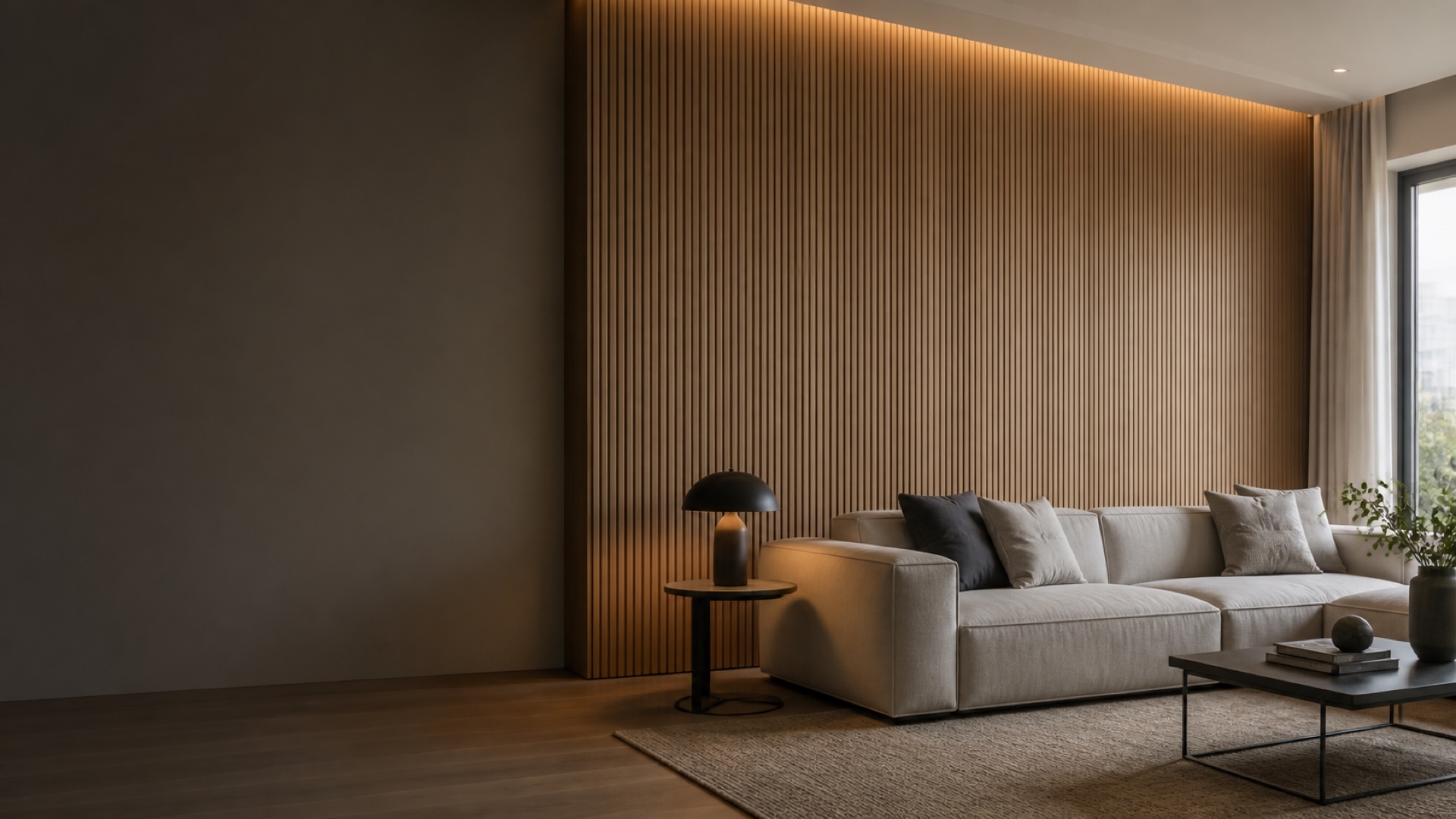
We make fluted panels every day, and they sell. Still, the question we get most from new buyers isn't "how good are they?" It's closer to "what's going to go wrong?" Fair enough. The disadvantages of fluted wall panels are real, most of them come from the grooves themselves, and nearly all of them can be managed if you pick the right profile before you order.
Here is the list we give our own distributors. No sales gloss. Each point ends with what you can actually do about it.
The Short Answer
- Grooves collect dust, so cleaning takes longer than on a flat wall.
- Narrow profiles mean many more pieces and joints than flat sheets.
- Ribs are directional: cut ends, sockets and corners need planning.
- Hollow profiles show their chambers at every cut end.
- The surface is a film, so it can't be sanded and refinished like timber.
- Uneven walls and side lighting make wavy ribs obvious.
- Standard fluting is decorative; it does very little for acoustics.
- A strong pattern can date faster than a plain wall.
1. Dust Sits in the Grooves
This is the one everybody mentions, and it's true. Every groove is a little ledge. Near air-conditioning outlets, in restaurants, in any room with foot traffic, dust settles along the ribs and shows up in side light.
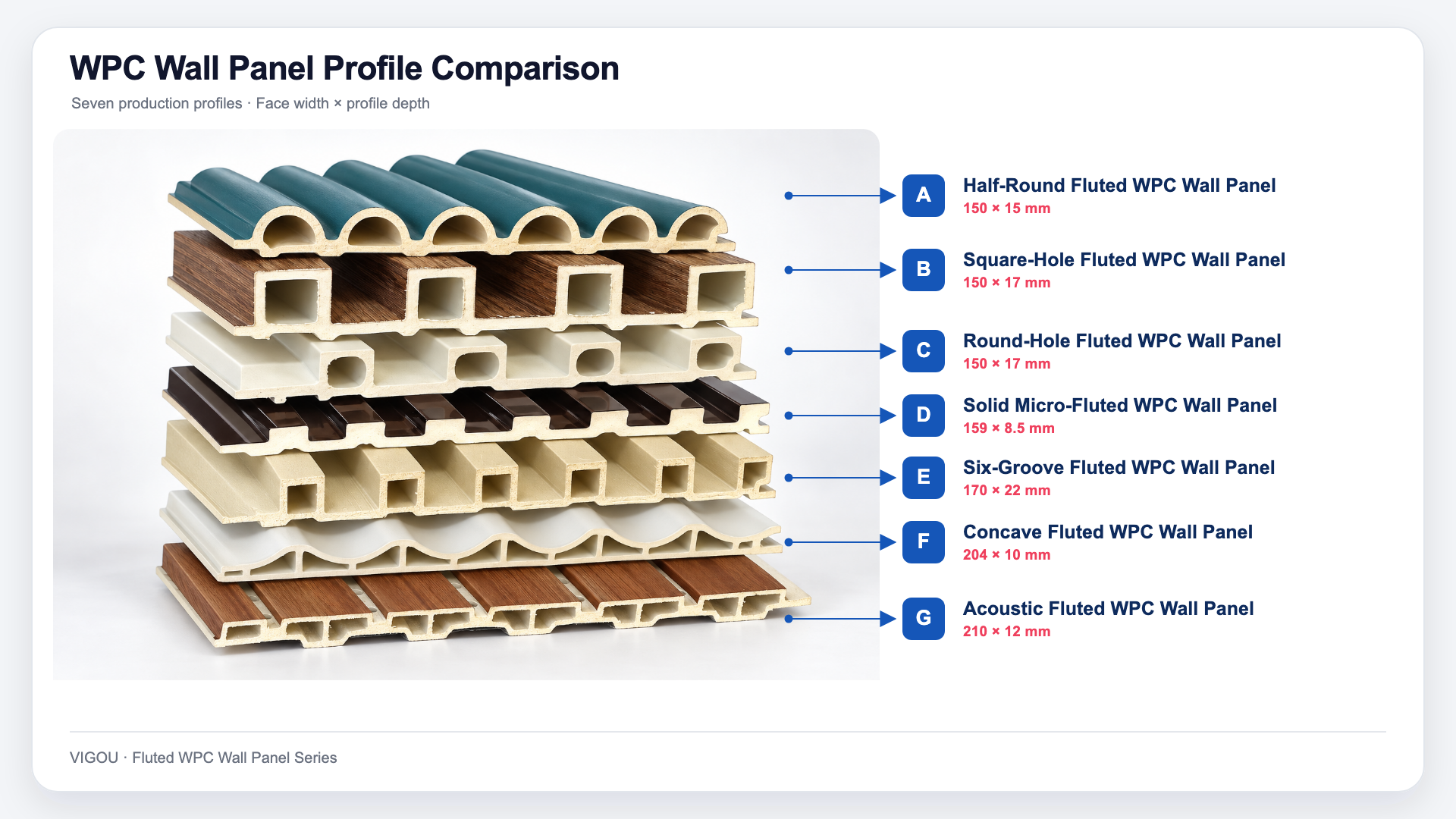
Depth makes a big difference. Our half-round profile has 15 mm of relief with rounded ribs, so a cloth slides along it easily. The six-groove profile is the deepest in our range at 22 mm, which looks dramatic in a lobby, but it also traps more. For a hotel corridor that housekeeping wipes every week, we'd steer you to the shallower, rounded shapes.
What to do: use deep profiles where people look, not where people touch, and plan a soft-brush or microfibre wipe along the ribs into the cleaning routine.
2. Many More Pieces, Many More Joints
A flat PVC wall panel covers 1,220 mm in one go. A fluted profile covers 150 to 210 mm. On the same wall, that's a very different number of pieces to handle, cut and line up:
| Panel (face width) | Pieces across a 3,000 mm wall (approx.) |
|---|---|
| Half-round, square-hole or round-hole fluted · 150 mm | 20 |
| Solid micro-fluted · 159 mm | 19 |
| Six-groove fluted · 170 mm | 18 |
| Concave fluted · 204 mm | 15 |
| Acoustic fluted · 210 mm | 15 |
| Flat PVC wall panel · 1,220 mm | 3 |
Each profile is light and quick to fix, so the extra pieces don't automatically mean an extra week on site. But installers do spend more time keeping the ribs plumb across the wall, and every joint is one more place where a small error shows.
What to do: if labour is expensive in your market, look at the 204 mm concave profile. It covers the widest face of our hollow profiles, so there are fewer joints per wall. Or do what a lot of our project buyers already do: flat PVC panels on the big areas, fluted panels only on the feature wall.
3. The Ribs Have a Direction
A flat sheet doesn't care which way it's cut. A fluted wall does. The ribs run one way, so the last piece at a corner is often a narrow strip, sockets and switches land in the middle of a rib or a groove, and the top cut at the ceiling has to be clean because the eye follows the lines straight up to it.
What to do: set the layout out from the centre of the wall (or from the TV, the bed head, the reception counter), so both ends finish with equal cuts. Mark sockets before the first panel goes up. Every model on our fluted wall panels page lists its exact face width and depth, so the count and the cut positions can be worked out on paper before anything is ordered.
4. Hollow Chambers Show at Cut Ends
Most fluted WPC profiles are hollow. That's deliberate: the chambers keep weight per square metre down, which helps on large walls and in shipping. The catch is that wherever a hollow profile is cut, at a door frame, a window reveal or the top of a half-height wall, you see the chambers.
What to do: decide how every exposed end will be finished before ordering: run panels into a ceiling line, cover ends with a trim, or use the solid micro-fluted profile. That one has no chambers and is only 8.5 mm deep, which is why buyers use it for ceilings and tight reveals.
5. The Finish Is a Film, Not Solid Wood
Our fluted panels come with a film-wrapped wood-grain or solid-colour surface. It looks consistent from panel to panel, which real timber rarely does, and it never needs oiling or varnishing. The flip side: a deep gouge goes through the film. You can't sand it out and re-stain it like an oak slat wall.
What to do: in high-risk spots (luggage trolleys, chair backs in a restaurant, school corridors), keep the fluting above the knock zone or protect it with a dado rail. Order a few spare lengths from the same batch so a damaged piece can be swapped instead of patched.
6. Wavy Walls Become Wavy Ribs
Vertical lines are unforgiving. If the wall bows, the ribs bow with it, and a grazing light from a window or an LED strip (very common on fluted feature walls, like the one in the photo above) makes every dip look twice as deep.
What to do: check the wall with a long straightedge first. Where it's out, fix the panels to battens that have been packed level rather than straight onto the plaster. It's the same preparation we describe in our guide to common installation mistakes.
7. Standard Fluting Isn't an Acoustic Panel
Fluted walls look like the acoustic slat walls in recording studios, and some buyers assume they work the same way. A normal fluted profile is a decorative surface; the ribs break up reflections a little, but they don't absorb much sound.
What to do: if sound matters (meeting rooms, studios, restaurants), specify the acoustic fluted profile. It has a perforated back with acoustic backing, and that, not the ribs, is what does the work.
8. Strong Patterns Can Date
Fluting is popular right now, which is exactly why it carries a trend risk. A whole room of ribs can feel busy in a small space, and in five years it may look of its time.
What to do: use it where it earns its place. One feature wall, a TV wall, a headboard wall or a reception backdrop. Keep the rest of the room calm. Re-cladding one wall later costs far less than redoing four.
Which Profile Minimises Which Problem
| If your main concern is… | Look at | Why |
|---|---|---|
| Cleaning time | Half-round, 150 × 15 mm | Rounded ribs, moderate depth, easy to wipe |
| Number of joints | Concave, 204 × 10 mm | Widest hollow face in the range |
| Exposed cut ends / thin build-up | Solid micro-fluted, 159 × 8.5 mm | No chambers, thinnest profile |
| Sound in the room | Acoustic fluted, 210 × 12 mm | Perforated back with acoustic backing |
| Maximum visual depth | Six-groove, 170 × 22 mm | Deepest relief; plan for more dusting |
All seven profiles come in the four standard lengths: 2,440, 2,600, 2,800 and 3,000 mm. Picking a length close to your ceiling height saves offcuts.
So, Should You Still Use Fluted Panels?
For most interior projects, yes, as long as you're honest about where they go. Fluted panels are at their best on feature walls, TV walls, bedrooms, hotel lobbies and corridors, office receptions, restaurants and retail display walls. They're at their worst wrapped around an entire small room, or on walls that take daily knocks.
One more practical point: our fluted WPC is an interior product. If the brief says exterior cladding, that's a different specification.
Before committing a container, get samples of two or three profiles and test them the way your site will treat them: wipe them, knock them, cut them. Our sample testing guide walks through it.
Compare the Seven Profiles Before You Order
Tell us the wall size, the room type and your destination port, and we'll suggest a profile and send samples of the finishes you shortlist.
Request Samples & a Quote →Frequently Asked Questions
Do fluted wall panels collect dust?
Yes. Every groove is a small ledge, so dust settles along the ribs, more so on deep profiles and on walls near air vents. A soft brush or a microfibre cloth run along the ribs every few weeks is usually enough. If cleaning time matters, pick a shallower profile.
Are fluted wall panels harder to install than flat panels?
They take more pieces and more joints per wall. A 3 m wide wall needs about 15 to 20 fluted profiles, against roughly 3 flat sheets 1,220 mm wide. Each piece is light and quick to fix, but the layout, the cut ends and the cut-outs need more planning.
Can fluted WPC wall panels be used outdoors?
Our fluted WPC range is made for interior walls: feature walls, bedrooms, hotel lobbies, offices, restaurants and retail. For exterior cladding, choose a product that is specified for outdoor exposure.
Are fluted wall panels going out of style?
Any strong pattern can date. Fluting is safest on one feature wall, a reception backdrop or a TV wall, with flat panels or paint on the surrounding walls. That way the look can be refreshed later without stripping a whole room.