Budget Shower Wall Panels: Where Cheap Panels Cut Corners
Budget shower wall panels are everywhere on trade platforms, and some of them are genuinely good value. Others are not. The problem is that the panels that cut the most corners look almost identical to the ones that don't, right up until they don't — a surface peeling three years into a hotel refurbishment, or a board flexing noticeably under hand pressure on the first fit. We've seen both, from our own early development runs and from samples customers bring us when they're shopping around. So here is the factory side of the story: the three places manufacturers actually reduce cost, what each one does to the panel over time, and what a buyer can check before the order goes in.
Why "Budget" in Shower Panels Means Something Specific
Shower and bathroom wall panels are a wet environment product. The panel sits in front of water, steam, cleaning chemicals and thermal cycling every single day. What keeps a panel working for fifteen or twenty years in that environment is not complicated — it's core density, board thickness, and surface film quality. Those three factors account for most of the production cost. When a supplier drops their price significantly below the market norm, one or all three of those factors has been adjusted.
That doesn't mean every low-cost panel is a problem. Some manufacturers reduce cost by running larger volumes, negotiating better raw material contracts, or competing hard for market share. But the reduction has to come from somewhere. Knowing where it usually comes from is the fastest way to separate a sensible deal from a liability.
Corner 1: Core Density
SPC shower wall panels — the standard material for this application — are made from a mix of limestone powder and PVC resin pressed together under heat. The ratio and pressing conditions determine how dense and rigid the final board is. A well-pressed SPC core feels solid. It doesn't flex when you push against it, it doesn't bow on the pallet, and it doesn't transmit small surface variations from the wall behind it.
A lower-density core does all three. It costs less to produce because it uses less limestone per square metre and is pressed for a shorter cycle. The difference in feel between a standard-density board and a lightweight one is immediately obvious if you hold both — the cheap one feels almost hollow by comparison, like the difference between solid timber and hollow-core MDF.
In a shower, low core density creates two specific problems. First, the board flexes under thermal expansion and contraction. Hot water, cool air, repeat. Over time that cycling works the adhesive bond loose at the edges. Second, the reduced rigidity means that any unevenness in the wall behind — a slight ridge, a tile edge under an overlay board — telegraphs through to the face. You get visible shadows on what should be a flat surface.
What to check: ask the supplier for the board weight per square metre at the specified thickness, or weigh a sample yourself. A 5 mm SPC shower wall panel at 1,220 × 2,440 mm typically lands around 20–22 kg. If a sample of the same spec comes in noticeably lighter, the core has been lightened. Our factory QC walkthrough on core density grading goes through the measurement method in detail.
Corner 2: Board Thickness
Thickness is the most visible spec on a product sheet, and also the one most easily gamed. A 5 mm panel sounds straightforward — until you measure it. Budget production runs tolerate wider thickness tolerances: a panel may be labelled 5 mm but consistently measure 4.6 mm in the centre and 4.9 mm at the edge. That 0.4 mm is invisible on a spec sheet, but on a wall it shows as a slight step at every vertical joint.
More importantly, total thickness determines how much structural work the panel itself does. For overlay renovation — fitting panels directly over existing tiles or render — the wall behind does most of the work and a 3 mm or 4 mm board is usually fine. For new construction, or for walls with any variation in flatness, thinner boards follow the wall contour rather than bridging it. The result is a finished surface that looks slightly rippled rather than truly flat.
Our shower wall panels come in 3, 4, 5, 6, and 7 mm thicknesses. For a hotel bathroom or any installation where visual quality is the main spec, 5 mm and above is the starting point. The 3 and 4 mm boards are designed for specific renovation scenarios, not as a cost-saving substitute in full refurbishments.
What to check: measure a sample with a calliper at five or six points across the sheet. Any nominal-to-actual gap over 0.2 mm, or significant variation within one sheet, is a quality control issue. That same inconsistency will appear in the printed surface texture and in the joint lines on the finished wall.
Corner 3: Surface Film
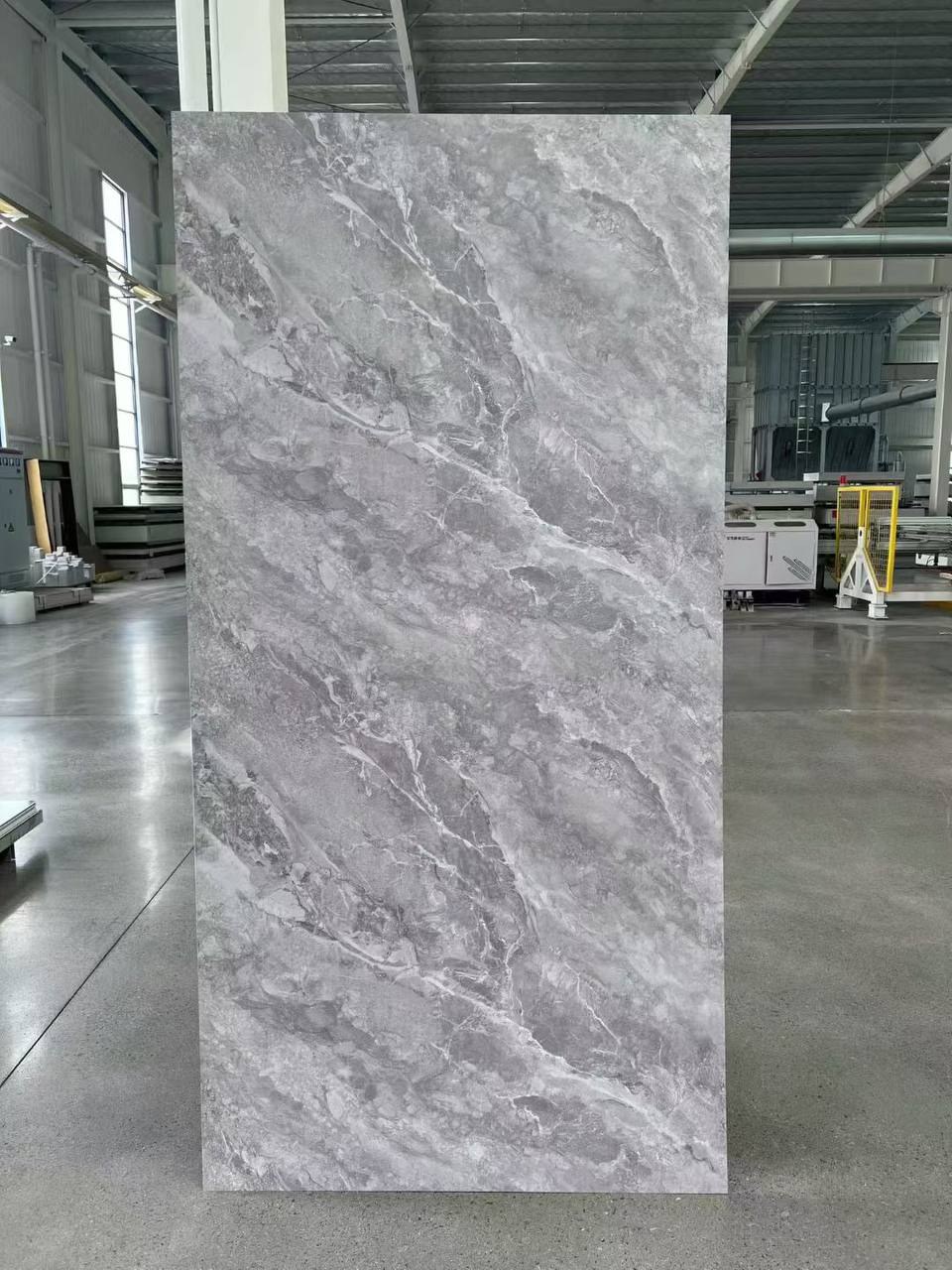
The face of a shower wall panel is a film layer bonded to the SPC core. The film carries the visual design — tile effect, marble, stone — and determines how the surface holds up to cleaning chemicals, steam, and direct water contact over years of use.
Budget panels often use a thinner film, a lower-grade base material, or a weaker adhesion process. None of that is immediately apparent in a photo, and it may not be obvious from a quick sample inspection either. The difference shows up over time: the finish yellowing, the film lifting at a cut edge, or the surface texture wearing through in the areas that get the most contact.
One specific thing to watch is how a panel handles its cut edges. When you cut SPC panel on site — to fit around a socket, to bring a sheet to width, to fold around an external corner — the cut edge exposes the core. A well-made panel has a surface film that runs cleanly to the edge and doesn't start to peel the moment a blade passes through it. A poorly bonded film lifts. Lifting edges in a wet environment let water track behind the board, which is the beginning of the end for adhesion.
The other tell is colour stability. In a bathroom there's no direct sunlight, but fluorescent and LED lighting over years of daily use will fade a low-grade surface more than a high-grade one. For hotel bathrooms expected to look consistent across a 100-room block after five years of use, film grade matters more than it might appear on initial inspection.
What to check: ask for a cut sample and fold it. A good-quality panel folds to a right angle on an external corner without the film cracking or peeling. Run your thumbnail along the cut edge — a well-bonded film doesn't lift. Soak a small piece in hot water for thirty minutes, then check the edge again.
Corner 4: Edge Finish and Panel Straightness
This one matters most on the production floor when contractors are fitting. Budget panels often have less precise edge finishing: the long edges are not quite square, there is minor bow along the length of the panel, or the cut ends have small chips and rough spots. Each of those problems adds fitting time and creates potential joint-line issues.
A bowed panel can be pulled flat against a straight wall, but it puts tension into the adhesive bond from day one, and it usually shows as a slight wave in the finished surface under raking light. On a hotel project where bathrooms are under site lighting during fit-out and then inspected under bright bathroom fixtures, wavy joints on what should be flat-sheet installation are a common snagging item.
What to check: lay a panel flat on a level surface and check for bow along both axes. For a 1,220 × 2,440 mm sheet, a bow of more than 2–3 mm over the full length is a quality concern. Run your eye along the long edge — it should be straight enough that you can't see daylight between the panel and a straightedge.
Putting It Together: What to Ask Before the Order
When you're evaluating a budget shower wall panel from a new supplier, the spec sheet alone isn't enough. Here's the short version of what to verify on a physical sample:
- Weigh the sample and compare it against the nominal weight for that thickness and size.
- Measure thickness at multiple points with a calliper; check for variation within the sheet.
- Fold a cut piece around a 90-degree corner and inspect the film at the fold.
- Soak in hot water for thirty minutes and check the cut edges for lifting.
- Lay flat and check for bow; run a straightedge along the long edges.
- Put a sample against a wall with the light at an angle — any surface texture inconsistency shows up clearly.
None of this takes more than an afternoon. For importers and distributors who handle hundreds of units per container, it's the difference between a smooth sell-through and a wave of callbacks twelve months after installation. For a full look at how durability specs vary across the market, our guide to PVC wall panel durability covers the grading system in more depth.
Samples Before You Commit
We send samples of any design in our SPC shower wall panel range before you place a container order. Test them against the checklist above and compare with what you have on the table.
Request Samples & a Factory Quote →Frequently Asked Questions
What makes budget shower wall panels fail early?
Three things usually decide how long a panel lasts in a wet room: core density, board thickness, and the quality of the surface film. Budget panels typically use a lighter, less dense core that can flex and crack under thermal movement; a thinner overall board that bends when you push on it; and a thinner or lower-grade film that peels or yellows when exposed to cleaning chemicals and steam over time.
How do I check shower wall panel thickness before ordering?
Ask the supplier to confirm the nominal thickness and the tolerance. A panel quoted at 5 mm should measure 5 mm ± 0.2 mm across the sheet, not vary from edge to centre. Request a sample, then measure it yourself with a calliper in several spots. Uneven thickness means uneven pressing during manufacture, which also hints at inconsistent core density.
Can I mix budget shower wall panels with standard ones on the same site?
Not unless they come from the same production batch, ideally the same run. Thickness and colour tolerances vary between grades and suppliers. Even a 0.3 mm difference in board thickness shows as a step at every joint. For a hotel renovation or a multi-room residential project, mixing grades is a common source of comeback claims.
What thickness do you recommend for shower walls?
For a shower or bathroom wall that sees daily water and steam, we generally suggest 5 mm and above in our SPC range. The 3 mm and 4 mm boards are designed for overlay renovation over flat, solid surfaces where the existing wall does most of the structural work. On new frames or on walls with any surface variation, thicker boards cope better and show fewer panel-line shadows.